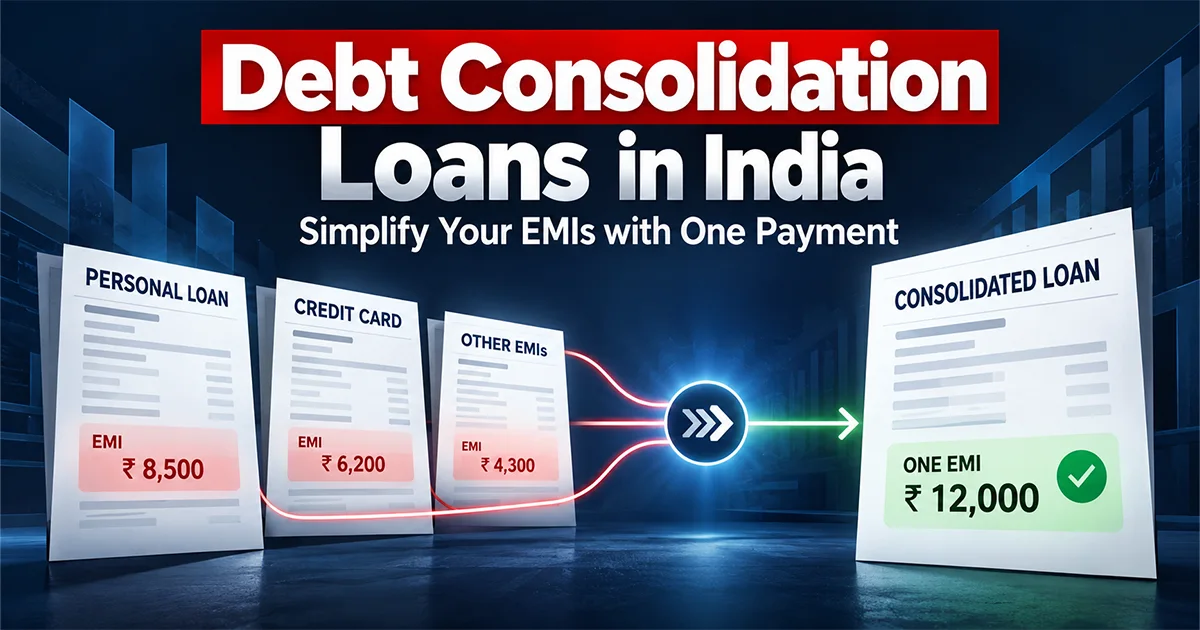

In India, a debt consolidation loan enables individuals to combine different loans into one loan with a fixed EMI. This means that instead of paying multiple loans with different payment dates, borrowers can repay their loans with a single EMI amount at possibly a lower interest rate. The benefits of using a debt consolidation loan include lower stress levels, easy tracking of payments, lower interest costs, flexibility of payment, and improved credit scores as a result of timely payments. Banks review normal retail banking criteria to determine eligibility, which includes age, income, credit score, job stability, and level of debt. Generally, you can apply for a loan online or at a bank branch by providing documents related to identity, address, income, and credit history. Borrowers should consider many of the mistakes to avoid when utilising a debt consolidation loan, including paying minimums on fixed payment loans, consolidating variable and low-interest debt, or climbing back into debt levels. Debt consolidation loans can relieve the borrower and create a pathway to long-term financial success with some personal discipline.
It's tough to deal with multiple loans at once. You have EMIs, interest rates, and a repayment schedule for each loan. If you miss even one payment, there is a penalty waiting for you. The dreaded penalties, fees, and damage to your credit score all come from missing a payment. A debt consolidation loan may be a smart solution for you if you find yourself juggling various loans. It allows you to move all of your current loans (personal loans, credit card dues, or any debts) into one debt consolidation loan with just one EMI - it's easier to pay one EMI than many. This potentially lowers your overall interest burden, makes repayment easier, and lowers the chances of missed payments. Fortunately, several banks and other financial organisations in India provide debt consolidation loans to help people manage their bills. This article will explain how debt consolidation works, what the benefits are, who can use it, and what to think about.
Having several loans can become overwhelming, especially if you have different EMIs (equated monthly instalments) due on different dates. Each loan has its own interest rates, terms, and conditions, which can create confusion in your financial arrangement. If this is your situation, a debt consolidation loan could help you get things back on track and make it easier to pay off your debts by merging all of them into one loan with one easy-to-manage EMI.
In India, debt consolidation loans are an increasingly effective way to consolidate your multiple debts on a single loan basis; with one EMI, you can manage them easily. Therefore, let's look deeper into a debt consolidation loan and how it works, as well as several other factors such as benefits, eligibility, and mistakes you'd like to avoid.
A debt consolidation loan provides the opportunity to combine all of your existing debts—such as personal loans, credit card dues, and other loans—into a single loan with a single monthly payment. This relieves you of the burden of making multiple payments each month or keeping track of different interest rates and due dates, among a few other things. Debt consolidation loans are developed to simply the repayment of loans and, frequently, lessen the total interest you will pay on the combined debt.
In India, many financial institutions and banks provide personal loans designed to consolidate their existing debt, allowing individuals to consolidate their debt into one loan, which they can then use to pay off their old loans and monitor repaying only one EMI for the new loan.
Managing multiple loans at one time can feel overwhelming and create further anxiety. You might forget to make your full payment or make a partial payment, and as a result, you may be charged late fees and penalties. Debt consolidation loans enable you to:
Instead of dealing with multiple EMIs and paying dues for multiple loans, you can make just a single payment each month. Doing so will lessen the chance that you will miss your payment and help keep things organised.
If you’ve been paying a high-interest rate for your credit card or personal loan debt, then you can consolidate that debt into a personal loan for debt consolidation, thereby reducing the rate of overall interest burden. Furthermore, if you have a credit score that shows an ability to manage credit, the banks that offer consolidation loans will most likely charge a lower interest rate.
It will be much simpler to manage your loans once they have been consolidated into one loan. You will only have to remember one due date, worry about just one EMI, and track a single loan balance.
When you consolidate debt and make timely payments on your new loan, consolidating the debt not only improves your monthly cash flow standing but may also help improve your credit score (if you are still managing to pay your bills responsibly). Once any debt is paid off, your outstanding loan or credit debt will decrease, thus improving your overall credit utilisation ratio and possibly boosting your score.
Many banks and financial institutions may give you flexibility with the repayment term for the purpose of consolidating your credit debt that may be spread out over time. Changing your loan term may allow you to extend your repayment tenure to an increased payment term, thereby decreasing your monthly EMI. The longer term may make your monthly payment much more manageable.
Before you proceed to apply for a debt consolidation loan in India, it is vital that you meet specific eligibility requirements. These requirements will vary, lender to lender, but usually include:
Most banks and financial institutions look for the age of the applicant to be between 21 and 60 years.
Most lenders are looking for stable income to ensure you will be able to repay the loan. The financial institution typically has a minimum required monthly income, which can vary from lender to lender.
Your credit score is an important aspect in determining your eligibility. While most lenders would like to see a credit score above 650, typically, the higher your credit score, the lower the interest rate.
Some lenders may only extend a debt consolidation loan after your total outstanding debt is above a certain amount. Lenders will also assess evidence of debt-to-income ratios to see if you can manage the new loan's EMI.
Usually, they will also require you to be employed in a stable occupation. Self-employed people may still qualify, but may need to document evidence of income stability.
Applying for a debt consolidation loan is not complicated. You can do it online or in person at a bank or other lender. The steps are the same:
The first thing you should do is compare the different lenders, their interest rates, loan periods, fees, and so on. Make sure you know what the lender's terms are and how they apply to you.
Once you've picked a lender, you'll need to think about what documents you need to send them. In virtually every instance, you will require the following:
Identification (Aadhaar, PAN card, passport)
Documents that show where you live, like utility bills, lease agreements, and other papers
Proof of income, including pay stubs, bank accounts, and tax records
Credit report (if you need one)
After your application has been processed, they will evaluate your ability to repay the loan using your financial information and determine the amount that you qualify to borrow. After you are approved, they will send you the funds to deposit in your bank account.
After the funds are available in your account, the lender will typically pay the loans on your behalf. Then you would pay the consolidation loan with regular monthly payments.
Debt consolidation loans can help relieve financial stress.
Make sure to read the terms and conditions before you sign the loan agreement. Pay attention to interest rates, fees, and penalties when it comes to late payments.
Not all types of debt may work well when it comes to consolidation. You probably don’t want to consolidate debt with a very low-interest rate, such as a home or car loan, and if you have too many of those loans and consolidate, you risk not being able to pay back the loans.
Debt consolidation will only work when you take the necessary steps to stay current on your payments. If you miss payments on the new loan, you could incur penalties and worsen your credit score.
Debt consolidation is a means to manage your debt, not to cure it. If you continue to rack up more debt after consolidating, you will find yourself in the same predicament. Therefore, you should evaluate your finances and create a monthly budget where you do not use credit cards or take out new loans for at least a period of time until you feel you have a handle on your finances.
In fact, many lenders may charge a processing fee, and there may be additional 'tricks' or hidden costs associated with your debt consolidation loan. Be aware of all fees so that you are not paying more than you expected.
If you use them correctly, debt consolidation loans might be helpful.
They can cut your monthly EMI (equal monthly instalments) by lowering interest rates and making it easier to pay back.
Simplify your finances by making only one loan payment each month instead of making payments on multiple debts.
Increase your credit score through timely payment of your debt and with a lower credit utilisation ratio.
Provide relief and peace of mind, a sense of control over your personal finances, and remove the mental burden of multiple debts.
Reduction of their total interest rates is one of the major reasons why individuals choose debt consolidation loans in India. In case you have several high-interest loans, credit card debts in particular, consolidating them can lead to a huge cut in the rate at which you will pay the new loan. This is particularly so when you have a good credit rating and you can convince your lender to charge you the lowest rate possible.
You will also save money in the long run through consolidating your debts, as you will not be paying high interest on credit cards or personal loans anymore. It is also easier to pay the principal within the shortest time possible through the lower interest rate paid on the consolidation loans, hence reducing the overall interest rate suffered in the long run.
It may be complicated keeping one or more loans with various due dates and different amounts outstanding. The lenders might be paying on different repayment schedules, and it becomes cumbersome to monitor payments and sums. This is made easy by a debt consolidation loan, where you organise all your debts into a single loan repayment.
The simplified EMI structure means you do not need to remember numerous due dates or due amounts, thus reducing the chance of not paying. Failure to pay various loans may hurt your credit rating, but a consolidated loan will enable you to monitor and pay them on time.
Pulling together your debts will assist in improving your credit score, as you might have missed on several occasions or had a high credit use on the credit cards. A debt consolidation loan assists in minimising the active debts that you owe to others and can help decrease your credit utilisation rate, which is a very important measure of your credit rating.
Through payments that are made on time in your new consolidated loan, you will be able to get consumer credit again and prove to be responsible financially. In the long run, this could enhance your credit score, which will help you get better financial deals, such as reduced interest rates on borrowed funds and credit cards in the future.
Balancing between several loans could be hectic, yet failure to pay any of the loans might lead to fines or an increase in interest rates. A debt consolidation loan would enable you to lessen this stress since you can definitely put all your loans together in a single payment, and therefore, it is easier to plan the budget.
Because you only have one EMI to consider, you will have more time to worry about how to manage your finances rather than maintain several loan schedules. This also avoids the chances of making late payments and the accompanying adverse effects that this brings about, like defaulting on more debt or even poor credit.
Debt consolidation loans can also enable you to clear your debt in a shorter period than when you had to deal with several loans with dissimilar rates of interest. Under a lower interest rate and with the possibility to concentrate all your efforts on the process of repaying a loan, you can speed up the process of debt abolition. This will assist you in getting down the debt ladder earlier so that your money can be used to achieve other objectives, like saving or investing towards the future.
The basic nature of a single loan and EMI lets you have a better understanding of how your future finances look. A debt consolidation loan has fixed terms; hence, you are privileged to know precisely what amount you will pay monthly and over what duration. This will enable you to make a more realistic forecast of your budget that keeps you on track.
I cannot have a financial plan when handling various loans because of the changing payments. However, in the case of debt consolidation, the financial issues become more stable and manageable, and you have better control over your money.
Perhaps the main benefit of debt consolidation loans outweighs these reasons, but it can be useful to compare it with other repayment options, such as credit card balance transfers and personal loans that are popular in India.
A balance transfer of credit cards is usually sold as a quick fix to consolidate credit card debt. With this option, you shift your card balances from one credit card to another that has a lower interest rate, and in some cases, it may be a 0 per cent rate within a period of introduction. But, as appealing as it sounds, the rate of interest can rise considerably once the initial period concludes.
A debt consolidation loan, on the other hand, offers a fixed interest rate over the loan term, which is a more reasonable option in handling debt. Moreover, a debt consolidation loan may be applied to consolidate a wider scope of debts (personal loans, among others, along with the debt on the credit card), not limited to credit card debt.
Another favourite is a personal loan for consolidation. These are also fixed-interest and alacrity-instigated loans, but with relaxed repayment features, tailored to that of a debt consolidation loan. The primary distinction is that personal loans may be allocated to any diversity of expenditures, other than debt solutions, like financing a house remodelling, or other personal requirements.
Nevertheless, similar to debt consolidation loans, the personal loans on consolidation offer a definite repayment schedule that includes a single EMI. The most important benefit of a debt consolidation loan, however, is that it focuses specifically on your current debts, whereby your attention is not entered regarding the expenditure of fund incursions on other spending types.
Although it is agreeable that debt consolidation loans have some distinct advantages in India, it must be noted that there are some things they need to consider before taking one:
Eligibility Requirements: It normally depends on your credit score, income, and existing debt levels, which are considered by the lenders in order to assess your eligibility. To find good conditions in a loan, if you have a high credit score and a steady income, you will have better chances of having favourable conditions in the loan.
Interest Rates and Debt Term: The debt consolidation loan has a low interest rate, but you need to pick the loan term that will help you reach your financial goals. If you have a longer term, your EMIs will be smaller, but you may also end up paying more interest overall.
Financial Management Discipline: The debt consolidation loans would be more effective only when you are determined to stick to the precise discipline to make the payments. You should not accumulate more debt even as you are paying off the consolidation loan.
In India, a debt consolidation loan is a great way to streamline your finances and ease your burden by better managing multiple debts. When you consolidate numerous loans into one, it will be easier to keep track of your money. This is because you will have reduced interest rates from the new lender, which will help you organise your finances better. However, it’s also important to keep in mind that debt consolidation is not a solution to overspending; it works only if you are disciplined with payment and don’t accrue new debt. Also, before you fill out and submit the application, consider if the lender is reputable and compare their loans to ensure that you can also keep an eye on things like eligibility and terms (especially interest rates and fees). Used correctly, they can also promote your credit score improvement over time and incrementally attain your financial peace of mind. Finally, debt consolidation is a tool for dealing with financial distress, but it could work to better manage your finances, only if you can manage to do it.
Que: What is a debt consolidation loan in India?
Ans: A loan that combines a lot of loans into one loan with one EMI, which makes it easier to pay back.
Que: What are the main benefits of debt consolidation?
Ans: Lower interest rates, one EMI payment, better credit scores, and less financial stress are some of the main perks.
Que: Who is eligible for a debt consolidation loan?
Ans: Most of the time, you need to be between 21 and 60 years old, have a solid job, a credit score of at least 650, and debt levels that you can handle.
Que: What mistakes should I avoid with debt consolidation?
Ans: Don't miss EMI payments, combine loans with low interest rates when you don't need to, or take on new debt after consolidation.

Founded in 2015, Ahk Tips is a New Delhi-based financial advisor specializing in debt relief and loan management solutions.