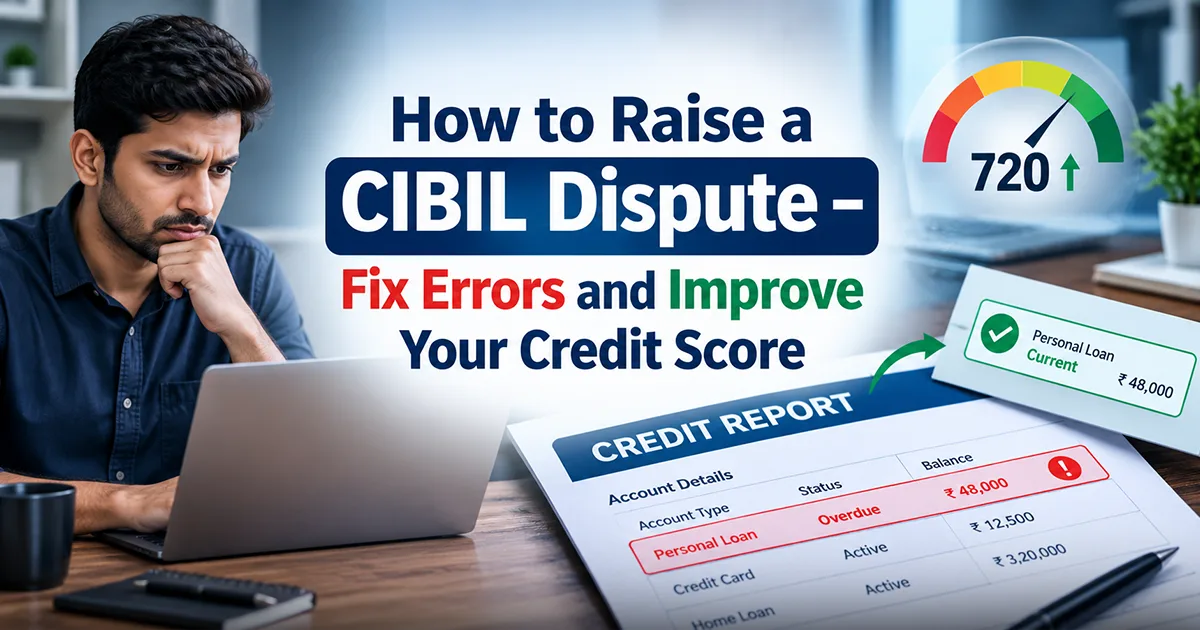

A CIBIL score is significant in the acquisition of loans, credit cards, and any other financial product. However, in some cases, mistakes on your CIBIL report, such as incorrect information, accounts open twice by you, or fake late payments, can damage your score. Fortunately, the CIBIL dispute represents a chance to remedy those errors. This can be corrected by obtaining your CIBIL report, identifying or detecting errors in the report and initiating an online dispute with evidence. CIBIL updates the report once verified, and your score has a chance to improve. This will assist you in getting loans and credit cards at better rates. Checking your report regularly, closing accounts correctly and paying on time are also helpful in avoiding errors. Correcting CIBIL errors will make sure that your credit report is accurate, and thus your credit history will be untarnished.
Financial freedom in India is the possession of a good CIBIL score. This score is checked by lenders, banks and credit card companies to approve any application. Nonetheless, the slightest mistakes in your CIBIL report can negatively affect your score and damage your prospective credit procurement, such as old loan details, unsolicited credit checks, and assumptions of defaults. The positivity is that CIBIL has a straightforward online procedure to raise disputes and rectify these mistakes. It is possible to correct your report in time and increase your score by providing the corresponding documents. This is a guide on the most common mistakes, how to escalate a CIBIL dispute and why it is necessary to dispute these errors to have a more stable and healthier credit score and financial prospects.
A credit score is essential for loans, credit cards and other financial products in India. But what about damaging inaccuracies on your CIBIL report that can bring down your credit score and weaken your chances of obtaining good financial conditions? Luckily, there is the CIBIL grievance redressal to help you locate and rectify these errors, thereby raising your credit score. If you have discrepancies on your CIBIL report, it's important to act fast. In this guide, we tell you how to raise a CIBIL dispute to rectify errors and improve your credit score.
A three-digit score between 300 and 900. Your CIBIL score is the number that indicates your creditworthiness. This score is used by banks and lenders to assess your eligibility for loans, credit cards and other forms of financing. The higher your CIBIL score, the better loan payer you are and with a low score, the risk could be higher. This is why keeping an updated CIBIL report is very important, as even a fintech error can affect your score and, hence, the availability of financial products.
Mistakes in your CIBIL report can have serious consequences. Some of the most common mistakes are:
Incorrect personal information: Mistakes in your name, address, or other personal information.
Mistaken payment history: Your report shows payments have been reported as missed or late, even though you paid each bill on time.
Outdated information: Closed loans that still show are still showing as open or unpaid.
Duplicate accounts: One loan or credit card shows multiple times on your report under multiple entries.
Unauthorised inquiries: Your report has an inquiry on a credit inquiry you did not authorise.
Finding these errors is the first step to raising a CIBIL dispute and fixing your credit report.
The idea of appealing a dispute with CIBIL is easily attained, but one must be more keen on details. Errors on your credit report can be fixed using two steps:
The initial step that you should take is to request a CIBIL report copy. This is available on the official CIBIL webpage, where, upon instructions, you can access your report. According to Indian laws, you have a free credit report every year. You may also decide to pay for a larger number of reports in case you need to do it more often.
After having your report, carefully examine it to determine whether you have made any mistakes, such as giving incorrect personal details, bad loan status or any discrepancies with payment histories.
When you have your CIBIL report, you have to carefully look through it to notice any discrepancies. The problems that are common can be wrong loan information or wrong payment history. In the case of each mistake, gather evidence to prove you are correct. As an example, when your payment record is already wrongly declared overdue, collect bank statements or receipts to establish that you have paid on time. On the same note, when old loans are reported to be in existence, take note and record that the loans were closed or disposed of.
Make sure you have all the relevant documentation needed to support your claims when presenting the dispute.
To file a dispute, one has to go to the CIBIL site and follow the dispute resolution tab. Enter your account (or create one, in case you do not have an account). In the dispute page, there will be a list of all your entries in your CIBIL report. Each of the errors will have a possible dispute option.
You will be required to choose the nature of the mistake, expound on the nature of the problem, and provide attachments. Be direct, yet brief in the explanation so that there is no misunderstanding. The more particular and clear your contention, the quicker the resolution process will run.
After you have made the dispute, CIBIL will send your complaint to the concerned lender or financial institution. The lender is required to reply within a stipulated time period, most commonly being 30 days. CIBIL will then proceed to find the hitch depending on the details that you have submitted and the lender's reaction.
One should be updated with the proceedings of his/her dispute. Online monitoring of the progress can be done on your CIBIL account, which will update you as the process of the investigation proceeds.
Once the investigation has been carried out, CIBIL will issue you with the outcome of the dispute resolution process. In case your dispute is won, the erroneous information will be reflected in your credit report and score, and it will be corrected. Such a new score could lead to a better score of creditworthiness, particularly when the errors were hurting your score.
On your getting no response in your favour, you can demand some additional explanation from CIBIL or the respective lender. In other instances, you might be required to step up the matter or even place a formal complaint to a consumer protection agency when you feel that the mistake has not been dealt with adequately.
As a credit card investor, a CIBIL dispute and errors that should be corrected on your report can make a great contribution to your credit rating. Mostly, inaccurate information that includes the failure to pay on time, incorrect accounts, or inaccurate loan information can reduce your score, though you may have been a good person financially. By correcting such errors, your credit report will be more accurately shown, reflecting your actual credit behaviour, and this will help to improve your credit score.
Specifically, when the disagreement can eliminate the negative elements like due payments or defaults which were incorrectly reported, your credit score may experience a significant boost. This will increase your credit score, leading to your likelihood of getting better-term loans, credit cards, and other financial products.
Although you can solve the existing problems by escalating a dispute, it is also significant to be proactive in securing your credit. The following are some of the practices that will assist in preventing future errors:
Check your credit report regularly: You should make it a routine to look at your CIBIL report at least once every year to come up with such discrepancies early enough.
Check credit inquiries: Establish a warning for any credit inquiries or loan applications under your name.
Paying on time: You always want to make loan or credit card payments in a good manner to eliminate the possibility that you will get negative marks on your report.
Close accounts: Do this correctly when paying off loans or closing credit card accounts by ensuring that they are marked appropriately as closed in your report.
By using such best practices, one will have the opportunity to limit the possibility of mistakes in their report and make sure that their credit score remains correct.
Reasons as to Why It Matters to Correct CIBIL Errors.
Correcting your CIBIL report is not solely about the importance of bettering your credit rating, but also owning up to the key to your own economic destiny. With a high CIBIL score, it is possible to access improved terms of the loan, re-discounted interest rates, and increased financing. Fixing your credit report by correcting errors will make your credit report reflect your actual financial performance, and this will give you the highest odds of borrowing and obtaining credit products on conducive terms.
It is easy, and through these few steps presented in this guide, you can raise a CIBIL dispute, fix any mistakes with your credit report and improve your credit score. It is important to remember that a proper credit report is the basis of attaining your financial objectives and getting the best financial offers.
A good CIBIL score is essential in obtaining loans, credit cards and other financial products. Nonetheless, most people are not aware that there are differences in their CIBIL report, which can affect their credit rating and their capacity to get good credit conditions. It is important to know the common CIBIL errors and how to fix these errors in order to have a good credit report and also to increase the credit score. This guide will discuss typical CIBIL discrepancies and provide viable measures to correct them.
A CIBIL report can also be inaccurate for a number of reasons. Others are clerical errors, whereas some others might be more complicated. These are some of the most probable discrepancies that may hurt the CIBIL score:
The falsification of personal information like name, address or date of birth is crucial in a credit report. The misinformation or old information will confuse the credit history, which will influence the score. This happens especially where individual names or similar addresses are similar, hence a combination of credit data.
Reporting of payment history incorrectly is one of the most influential discrepancies. Even when you have paid on time, loan providers or credit card companies can report late payments or defaults to the credit ratings agencies. This may be as a result of mistakes in the payment books or lagging behind in updating the report.
The other error is a duplication of credit accounts in a CIBIL report. One loan or credit card can be recorded on several occasions, and this can result in an exaggerated credit utilisation ratio and a reduced score. This is normally a result of technical errors or old information in the system.
There are also chances of credit checks appearing on your report, but they are not authorised. This may happen when an individual uses your name to seek credit, or even simply because there is an error in the reporting system. Without permission, investigations into your credit may hurt your credit score, particularly when there are numerous or associated with numerous credit inquiries.
There are cases where settled loans or paid-off credit cards still appear as active under the CIBIL report. This occurs when the lender does not make any updates about the account after closing it. Consequently, there is a possibility that your report will indicate that you have outstanding money for a previously cleared account, which hurts yo u. How to Fix CIBIL Discrepancies
Having known the top ten types of CIBIL discrepancies now, it is time to know how to fix them. Cleaning up your credit report will increase your score, and then you will be able to get greater financial opportunities.
Before you start to rectify any discrepancies, the first step is to obtain a CIBIL Report. It can be requested on demand on CIBIL’s website. You are then entitled to a free credit report every 12 months. Read through the report carefully to find if there are any inconsistencies in your personal information, payment trends and account status.
Once you receive your CIBIL report, read it carefully and highlight the errors. (Note: Should you wish to override incorrect personal information, your payment history or multiple accounts.) Even after a firm informs the credit bureaus that you’ve paid as agreed, significant other supporting evidence is necessary to verify what you are saying, such as by providing bank statements or receipts to show that you paid on time, or that the account in question was settled.
CIBIL allows you to initiate disputes on its site. After logging in to your CIBIL account, navigate to the dispute section where you can register any discrepancies. For Each Question, choose the Appropriate Category of problem (i.e Payment status incorrect, duplicate accounts, etc), write brief explanations and upload any evidence documents to help your case.
You can place your dispute, and CIBIL will send the complaint to the concerned lender or financial institution. The lender will have a specified period of time (often 30 days) within which to respond. At this time, pull your CIBIL account often so you can see if a dispute is resolved. If the lender agrees with the dispute, he/she will update/rectify the information, and the CIBIL report will be updated accordingly.
After the investigation of the difference is complete, CIBIL will send information regarding the settlement. If the dispute is decided your way, the inaccurate data will be removed, and your score will likely increase. When arguing doesn't go your way, you can obtain further clarification or ultimately take it somewhere else. If there is a requirement to make a complaint to the Reserve Bank of India (RBI) or any other authority, under whose jurisdiction it operates.
Correcting such inaccuracies on your own is a sure-shot way to improve your CIBIL score. While the majority of these errors, such as incorrect payment history or old account status, can hurt your score even if you have displayed responsibility through financial behaviour. By resolving these errors, you can be confident that your credit history really is an accurate reflection of your real credit, which in turn may cause a noticeable improvement in your credit score.
In addition, resolving duplicate records or an unauthorised credit inquiry can drive down your use of credit ratio and, as such, leave you with a higher score. A better credit rating will improve your prospects of getting loans, credit cards and various other financial instruments at a more favourable rate, such as lower interest rates, etc.
Repairing your CIBIL report not only makes sense but also secures your financial future. Any mistake in the entry, such as duplication of accounts or wrong payments, may make you unable to take loans, credit, or get low interest rates. It is possible to make sure that your report is a true reflection of your financial history by posting a dispute online, uploading documents, and tracking the status. When it is amended, your points can be better, and you have more chances to be approved and get favourable conditions. Meanwhile, implementing the best practices, such as checking your report and closing your accounts, avoids mistakes in the future. A correct CIBIL report allows you to keep a good faith with the lenders, meet the goal set, and continue the process of credit smoothly and without pressure.
Que: What is a CIBIL dispute?
AnsA: A CIBIL dispute is the act of correcting any inconsistencies listed in a CIBIL credit report, for example, Incorrect information or misreported payments.
Que: How do I get a CIBIL dispute?
Ans: Just log in to the CIBIL website, select the error mentioned, enter the evidence, and file the dispute online.
Que: How much time does CIBIL take to resolve the dispute?
Ans: Normally, it will take 30 days at most as CIBIL has to correspond with the lender till the updation in the report.
Que: Would the fixing of these errors affect his credit score?
Ans: Yes. When these inaccuracies are corrected, the score will probably rise and consequently have a bearing on the loan and credit card being offered.
Next Post

Founded in 2015, Ahk Tips is a New Delhi-based financial advisor specializing in debt relief and loan management solutions.