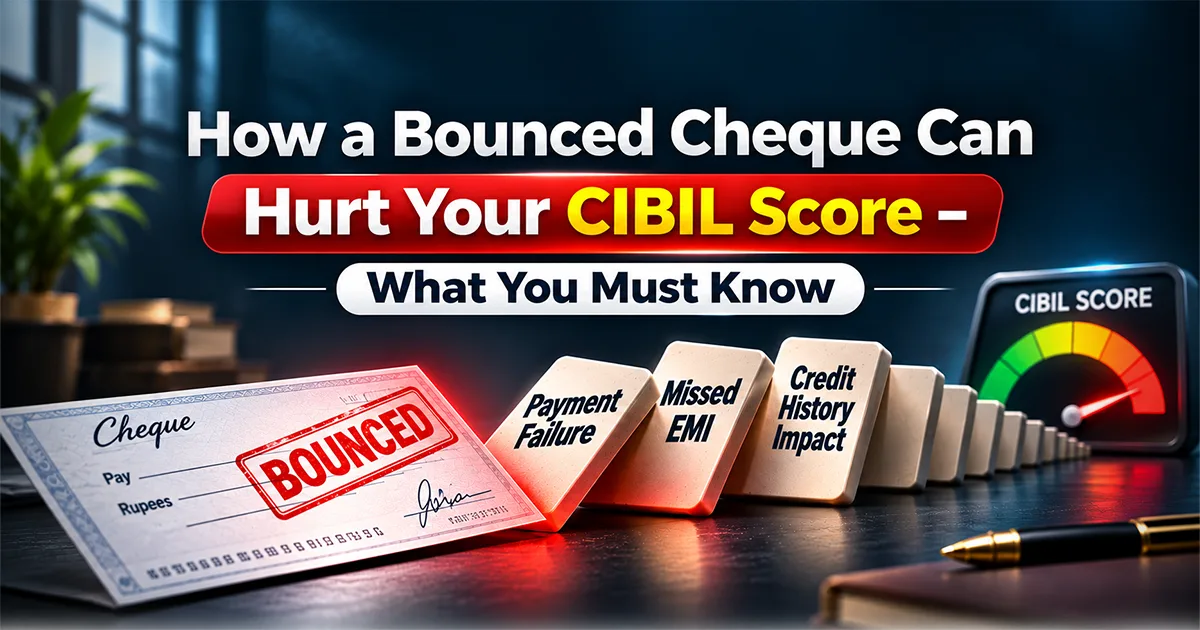

In India, a bounced cheque may lead to potential financial and legal ramifications. When a cheque is bounced due to insufficient funds, signature mismatch or incorrect information, you not only have to pay penalties levied by the bank and payee but also ruin your CIBIL score. These can be reported to credit bureaus and take 50–100 points off your score, remaining on the books for many years. This can hinder your ability to secure a loan, credit card or other financial product in the future. A bouncing cheque can also result in fines or imprisonment under section 138 of the Negotiable Instruments Act. The best way to avoid bounced cheques is to ensure you have enough money, good information, overdraft protection and electronic payment.
Your CIBIL score tells about your financial dependability, and as such even small errors can damage it. A bounced chequeSChar occurs when a bank refuses to process it because of insufficient balance or incorrect information. There is a perception that the only effect of a bounced cheque is charges, but that's not true — this can be so much worse. It gets reported to credit bureaus such as, say CIBIL and this lowers your credit score impacting any future loan or even credit approvals. Furthermore, the dishonour of a cheque can even invite criminal proceedings under Section 138 of NI act attracting penalties and imprisonment. In this post, you will learn why bounced cheques impact your CIBIL score and the consequences in the form of penalties, legal implications as well as measures to avert or get out of such situations.
In in your personal finance, you can then be thankful for you defense the vendor's score is that this Then again. It can help a lender decide if you’re trustworthy enough to repay a loan or credit card debt. Having a good CIBIL score gives you access to various financial opportunities like personal loans, home loans, credit cards etc. But some financial missteps — such as bouncing a check — can cause long-term negative effects on your credit score. This post will highlight the impact of a bounced cheque on CIBIL score, charges for it and what could be a legal action against you under section 138 NI Act in India as well.
A cheque is referred to as "bounced" when it is taken to the bank for payment, and although it was validly issued by the drawer, cannot be processed because of an inadequate check writing account balance. It can also be returned for the following reasons:
Mismatched signatures
Post-dated cheque
Inaccurate account details
Your CIBIL score is derived from your credit history and repayment behavior. Default or non-payment of dues works against this score. Here is how a bounced cheque impacts your CIBIL score:
If a bounced cheque is deposited, then CIBIL is made aware of the event by your bank or credit through which you have issued the cheque. This event gets reported to your credit history as a negative entry and damages your CIBIL score.
Late Payment/Default: If a cheque gets dishonoured, it is considered as if you have not made that payment. A bounced cheque Cheques make a poor impression A bounced cheque might not be a loan or credit card repayment, but it’ll signal to those who lend money that you lack control of your financial situation. Consequently, your score may decrease in CIBIL.
Although the total loss to your score might vary for a number of reasons, bouncing a check can shave as many as 50 to 100 points from your score. The degree of reduction is based on the type and number of such events in your record. And if a bounced cheque is bouncing due to a running loan or credit facility, it gets still worse.
A bounced cheque can stay on your credit report for several years. Even if you clear the pending dues, the negative impact on your CIBIL score might take time to recover. The longer the time elapsed without further incidents of default, the more likely your CIBIL score will start improving again.
A bounced cheque could lead to financial as well as legal repercussions in India. And penalties are not restricted to the hit to your credit score; they include money fines and worse — even imprisonment in certain cases.
When a cheque is returned, the bank typically charges a bounced cheque fee to the account holder. This charge may differ from each bank and is usually Rs 200 to Rs 500 or even more. You also happen to be the one who wrote and signed the cheque for that amount payable to the payee.
Under the Negotiable Instruments Act, 1881 a bounced cheque is punishable with imprisonment or fine or both. Paragraph 138 of the Act relates to dishonor of cheques. A bounced check may result from insufficient funds, in which case:
Demand Notice: Before anything you have to send the payee, a formal notice in which you tell that his cheque is bounced. The issuer has 15 days to satisfy the balance from receipt of the notice.
Avenue of Approach ( Remedies): If the cheque is not realised by the drawer during 15 (fifteen) days from the receipt of notice, the holder can file a criminal complaint. Punishment for issuing a bounced cheque Under Section 138 of the NI Act, the drawer of a bounced cheque can be punished with:
Imprisonment for up to two years, or
Fine up to twice the cheque amount, or
Both imprisonment and fine.
At times, the legal process can take months or even years longer and add to your financial reputation as well as losing loan-seeking capabilities.
The best way to handle the negative effects of a bounced check is to do everything in your power to avoid writing one. Here are some practical pieces of advice:
Before writing a check, always check to see if there's enough money in your account. You also need to constantly keep an eye on your balance and prevent neglect.
Reconcile your bank statements to your financial records monthly. What this will do is catch any inaccuracies before you cut the cheques and everything will be copacetic when they present the cheque.
Use online payment methods (if possible) rather than cheques to pay your bills because they are faster and less prone to errors. Digital payments are also easier to track and manage.
If you know that your cheque is not good, as there will be no money in the account to cover the cheque, notify the payee right away. Often, payees may be prepared to wait for a further payment or agree an alternative plan.
There are some times when you can prevent a big blow to the CIBIL score, if there is timely settlement of the cheque. However, if you are able to get a bounced cheque cleared – along with the related charges (including the penalty) and can avoid any legal action – then the effect on CIBIL score will be minimal.
And if the issue is resolved before it’s reported to CIBIL or appears in your credit report, then there might be little long-term damage. But if the cheque keeps bouncing or there is a long delay in settling of dues, then its effect on your credit score’s health will be severe.
If you are unsure whether a bounced cheque has impacted your CIBIL score, you may want to check the same on the official CIBIL website. This is updated every month though, so you should see changes after anything like this has been reported to you.
In case your credit score fell considerably because of the bounced cheque, then work towards rectifying it by repaying pending payments, preventing future defaults and over a period of time display improved credit behavior.
One of the most frequent problems that may lead to serious financial problems is a bounced cheque. As either a business owner or a person, you may find yourself in difficulties immediately when you file out a cheque that fails to go through because of lack of funds. One of the worst effects is that it may seriously harm your CIBIL score resulting in the future you will find it difficult to get loans, credit cards, or even other types of credit. Knowing how to prevent financial spills that can result when a cheque is bounced and being prepared to take the appropriate actions is what can save you long term headaches. This paper describes the financial implications of a bounced cheque, and how you can prevent or remedy the situation.
A cheque is bounced when a bank cannot process a cheque because of lack of money or any other problem with the cheque like wrong information. In the case of a bounced cheque, the payee (the individual or the body that the cheque was written to) is informed that the payment was not possible. This can easily get down to a sequence of financial problems both to individuals and businesses and one of these effects is that it affects your CIBIL score.
One of the most important aspects of your financial profile is Your CIBIL score. It is between 300 and 900 with a larger value showing improved creditworthiness. This score is used to determine the likelihood of you repaying a loan by lenders. This score may be greatly affected by a bounced cheque and this fact can negatively affect your future possibility of being approved when you apply loans, credit cards, or other financial products.
After a cheque bounces, this is reported to credit bureaus such as CIBIL. This is perceived as a bad event in your credit history, particularly when the cheque spent on the loan repayment, credit card repayments or any other recurring financial responsibilities. Although the cheque may be on a one-time payment on a personal transaction, it still reflects the failure in upholding your financial obligation.
The situation determines how the impact to your CIBIL score will be severe or not. In case the cheque returned due to lack of finance or defaulted payment, your CIBIL score may reduce to 50 to 100 points basing on the number of such instances and the overall history of your credit. A major loss of grade may result into difficulties in obtaining credit or borrowing in the future at increased interest rates or even failure to do so.
It is also possible that a bounced cheque can be left on your credit report over the course of several years; it still continues to impact your credit rating. It might take a long time to regain your score even after you solved the problem. There are some long-term impacts that can restrict your availability to financial products and services that can impact a range of car loans to business funding.
The CIBIL score is a big issue but it has some other financial implications of a bounced cheque that both the individual and the business must be aware.
Bounced cheques are charged by the bank a fee bounced cheque fee. Such penalty may depend on the policies of the bank but is usually between 200 and 500 rupees per bounced cheque. Higher penalties may also be given in case of repeated bounced cheques before that makes more out of your pockets.
The direct legal repercussions of a bounced cheque will depend on the Negotiable Instruments Act, 1881, in relation to any loan or debt repayment. This Act under Section 138 criminalises the dishonour of cheque because of inadequate funds. In case the issuer of cheques cannot clear the amount within a set time, the payee may sue and thus face fines or imprisonment.
In the case of a business, a bounced cheque may spell a bad reputation. It can be perceived by clients, customers, and vendors as one of the indicators of financial instability, leading to poor relations and the lost trust. This may influence business activities, business partnerships and even future contracts.
It is much better to prevent than to pay the price of a bounced cheque. The following are some of the steps you can take practically to prevent this situation:
The simplest method by which you avoid a cheque from bouncing is by maintaining records of your bank account. Keep a check on your account regularly to be sure that enough money will be in the account before you write a cheque. Most financial institutions have mobile banking applications where you can view balances in real-time which enables you to remain informed.
In case you worry that you will end up in a situation when you run out of money, it is a good idea to have the bank install overdraft protection. This service gives your bank the permission to repay the bounced cheque by automatically withdrawing an alternate source of funds including a linked savings account or a line of credit. Though there might be related costs, it can be a good insurance against cheque bouncing.
Ideally you can use an electronic money transfer such as NEFT, IMPs or UPI, since this takes less time and is more sure shot than a cheque. These forms of payment also are easier to monitor and reduce the probability of errors that could result in a bounced cheque. This is especially a concern with companies because it ensures quicker payment and avoids any delays that can slow cash flow down.
If you write a check, verify the details, such as the amount and payee’s name before handing it over. Some mistakes may lead to a cheque bouncing when you have more than enough money in the account. Confirming the facts can keep you out of trouble.
Ensure that your details are correct before issuing a cheque, that is, the amount, the name of the payee, and your signature. Any error may lead to the dishonours of the cheque even when there are adequate amounts in your account. Once you have confirmed the information, it can help you to avoid unnecessary complications.
But having a cushion in your account for unexpected expenses is always a smart move. And even if you have properly budgeted, unexpected fees or delays can lead to a shortfall. Keeping a little reserve can save you from bouncing the cheque with consequent penalty to be paid.
In case a bounced cheque has caused your CIBIL score to decline, there are remedies which you can use to restore it:
Settle Outstanding Debts: Repay all outstanding payments and don't let future payments hang in fire.
Dispute Errors: If there is a mistake in reporting of the bounced cheque listing you can dispute with CIBIL for correction.
Track Your Credit Report: Keep an eye on your credit report any negative events show up or if it seems that your score is not improving.
To bounce a check is more serious business than just the embarrassment of being declined for your canned soup and toilet paper. Bouncing checks can hurt your credit score, land you in legal trouble and ultimately reflect poorly on your fiscal responsibility to other financial companies down the line. Aside from bank fines, it reduces your CIBIL score and affects your upcoming credit approvals. Multiple cheque dishonours are not only damaging to your reputation in the eyes of lenders and business associates, but also under Section 138 of NI Act you could land up paying heavy fines or even be jailed. Prevention is best: keep an adequate balance in your account, add overdraft protection to your account, double-check cheque details or switch to more secure digital payments. If a bounced cheque causes your score to fall, clear dues fast, contest erroneous reports and start rebuilding your credit by making timely payments. Remaining vigilant and vigilant action will keep you from damaging your CIBIL score and financial integrity.
Que: Does a bounced cheque affect CIBIL score?
Ans: Yes. It is a negative listed item — and it can lower your score by as much as 50-100 points.
Que: What is punishment for bouncing of cheque?
Ans: Yes, you can be punished and sent to jail U/s 138 NI Act for twice the amount of Cheque.
Que: How can i prevent a cheque from bouncing?
Ans: Bring enough cash, verify information again, balance your checkbook/pay electronically.
Que: Can I get my CIBIL score back after the dispute on a bounced cheque?
Ans: Yes. Pay any remaining dues you owe, avoid future defaults and watch your credit report rebuild your score.
Next Post

Founded in 2015, Ahk Tips is a New Delhi-based financial advisor specializing in debt relief and loan management solutions.