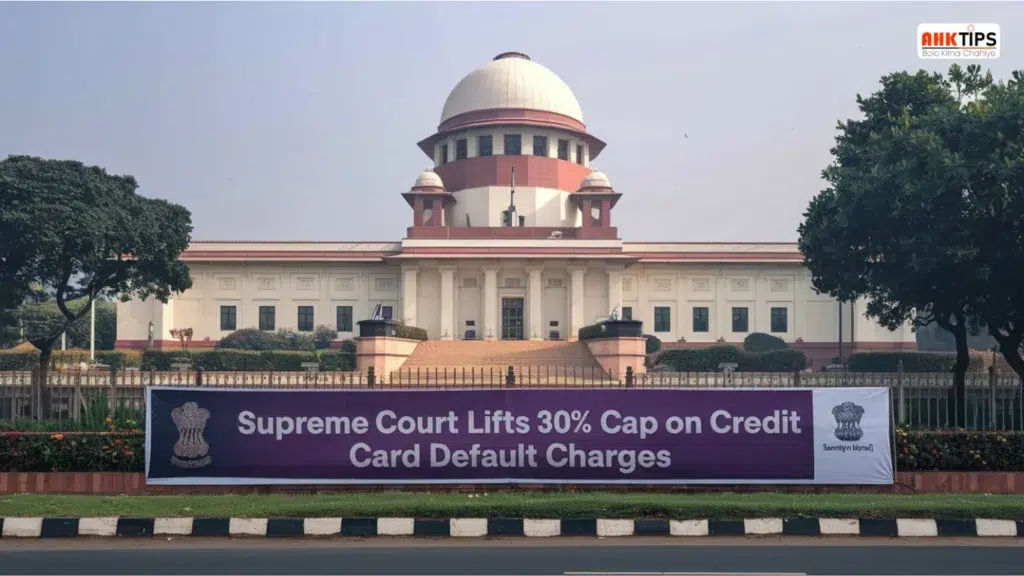

Using a credit card has become a common thing these days. Supreme Court lifts 30% cap on credit card default charges, It is a facility that can prove to be beneficial if used correctly. But, if it is used incorrectly or without thinking, it can become a big loan problem. Especially, when the credit card bill is not paid on time, the financial condition can worsen due to the heavy interest charged by the banks.
Recently, the Supreme Court has made a big decision related to the interest rates charged on credit cards. This decision has resolved an important issue for both consumers and banks. Let us understand it in a simple and detailed way.
Banks charge very high interest from consumers if their credit card bill is not paid on time. The matter reached the National Consumer Disputes Redressal Commission (NCDRC) regarding this issue. NCDRC had said in one of its decisions that charging 36% to 50% annual interest by banks from consumers is an unfair trade practice and had held it wrong. If any help for guidance to apply now.
NCDRC had limited the interest rate on credit cards to a maximum of 30%. The commission believed that the relationship between banks and consumers is unequal. Consumers have no choice but to accept the rules of banks. Therefore, charging such high interest to consumers is unfair.
However, this decision has been made by the Supreme Court. A bench of Justice Bela M. Trivedi and Justice Satish Chandra Sharma of the Supreme Court quashed the 2008 order of NCDRC. The court has said that banks have the right to charge more than 30% i.e. up to 50% interest from consumers.
This decision has given a big relief to the banks because now they can charge up to 50% interest on credit card defaults.
NCDRC had said in its decision that the interest rates being charged by banks in India are much higher than the rates applicable internationally. The Commission cited the interest rates applicable in different countries:
The Commission believed that it was unfair to adopt such high interest rates in a large and developing country like India. However, the Supreme Court rejected this argument of NCDRC.
After this decision of the Supreme Court, consumers have to understand that credit cards should be used very carefully. If the bill is not paid on time, then banks can now charge up to 50% interest.
This decision is like a warning for those consumers who do not use credit cards wisely.
If the credit card bill is not paid on time, the bank charges high interest on the pending amount. This interest can range from 36% to 50%. This amount increases rapidly and it becomes difficult to pay.:
This decision of the Supreme Court has definitely brought relief to the banks, but it will also have far-reaching effects:
International interest rates:
The situation in India:
The interest rate on credit cards is measured on an annual percentage rate (APR). This interest is applicable if you do not make the full payment. The interest rate is calculated as follows:
Example: If you have Rs 50,000 outstanding on your credit card and the interest rate is 36%, then the monthly interest rate will be 3%.
This decision of the Supreme Court lifts 30% cap on credit card default charges is a big lesson for consumers. It shows how carefully and responsibly a credit card should be used. If you use a credit card correctly, it can prove beneficial for you. But if it is misused, you may have to face heavy interest rates and penalties.
Using a credit card can fulfill your convenience and needs, but it is important to work responsibly for this. This decision of the Supreme Court is a warning for consumers to avoid credit card default.
Timely payment, correct planning and limited spending is the right use of a credit card. Remember, a credit card is a helpful tool, not a means of wasteful expenditure.
Que: How can the credit card interest rate be reduced?
Ans:
Pay on time.
Request a low-interest rate card from your bank.
Keep a good credit score.
Que: What happens if I am unable to pay the credit card?
Ans: The bank can send you a notice. If you do not pay for a long time, this matter can go up to legal action.
Que: What should be kept in mind while using a credit card?
Ans:
Avoid unnecessary expenses.
Use offers and reward points properly.
Understand the billing cycle.
Use the card only when needed.
Que: What does the Supreme Court’s decision mean?
Ans: The Supreme Court has overturned the NCDRC’s decision, which limited the interest rate on credit cards to 30%. Now banks can charge up to 50% interest.
Que: How to avoid credit card late fees?
Ans:
Make full payments on time.
Use auto-debit facility.
Plan your expenses.
Previous Post

Next Post


Founded in 2015, Ahk Tips is a New Delhi-based financial advisor specializing in debt relief and loan management solutions.