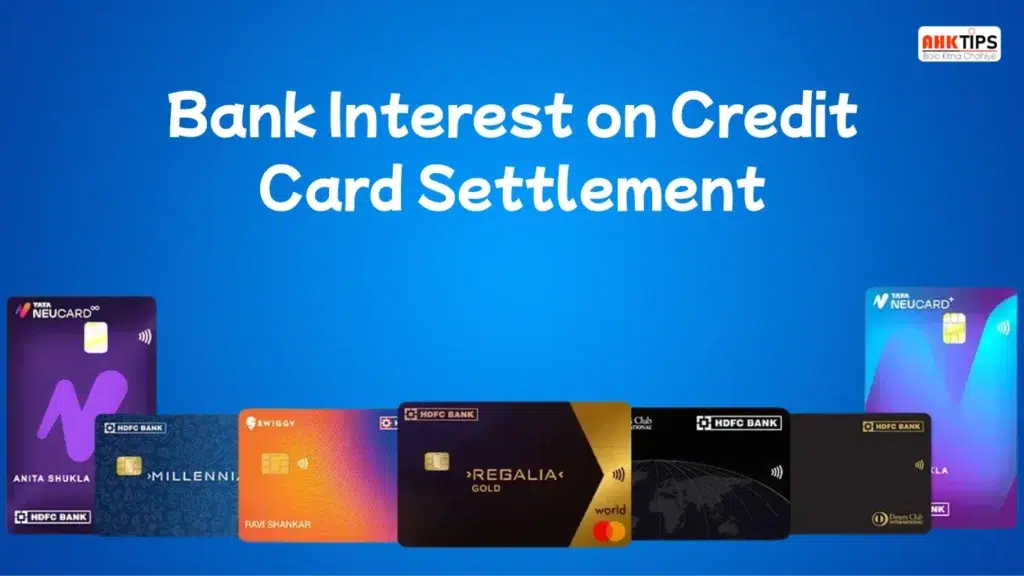

Credit Card Settlement is done when the customer is unable to pay the entire outstanding amount and gets some discount from the bank. However, an important question arises in this, whether the bank charge interest on settlement? The answer to this depends on the customer’s situation, the bank’s policy, and the type of settlement. Typically, the bank can charge interest and other fees at the time of settlement, particularly if the payment is made through installments (EMI).
Credit Card Settlement can negatively affect the CIBIL score, which can lead to difficulties in obtaining a loan or a new credit card in the future. Also, the bank may put the customer in the high-risk category after settlement, which may cause problems in getting financial facilities in the future. Therefore, it is important to get clear information about the interest and other charges from the bank before settlement.
It would be better if the customer pays on time so that there is no need for settlement. If you are having difficulty making the payment, asking the bank for an EMI plan or making a lump sum payment may prove to be a better option. This can reduce interest and additional charges. In the end, using credit cards wisely is the best way to avoid financial troubles.
Credit card is a very convenient financial tool, but if not used properly, it can cause financial trouble. When the cardholder is unable to pay the full dues of his credit card for some reason, he can opt for Credit Card Settlement. But this process comes with many difficulties, one of the biggest questions of which is – does the bank charge interest on Credit Card Settlement?
When a person is unable to pay his credit card dues on time, the bank or financial institution charges late payment charges, penalties, and high interest rates. If the situation gets worse and the customer is unable to pay the full amount, then the bank can offer him a settlement. Credit Card Settlement means that an agreement is made between the bank and the customer, in which the bank agrees to accept a certain amount by giving some discount from the total outstanding amount.
But the important question here arises does the bank charge interest even after this settlement? The answer depends on the customer’s situation, the bank’s policy, and the type of settlement. Usually, when a person opts for settlement, the bank may waive off or reduce the interest. But in many cases, banks charge a certain amount of interest during settlement as well, especially if the payment is being made in installments.
In this article, we will know in detail why and how banks charge interest on credit card settlements, under what circumstances the interest can be waived, and what measures should be adopted to avoid it.
Credit Card Settlement is a process in which you negotiate with your creditor to forgive a part of the outstanding amount on your credit card by making a lump sum payment. It is an agreement that you make with your card issuer as a last resort when you see that your credit card debt is increasing.
This can happen due to many reasons, ranging from unnecessary spending to careless spending habits. When your debt increases, the interest on it also increases, which can make it difficult for you to repay the outstanding amount. If you do not see any way out of this, then you can recommend Credit Card Settlement.
The following are some of its main features:
Below are some common reasons:
Although both Personal Loan settlements and Credit Card Settlements aim to provide relief to the borrower, there are some important differences between them.
| Points of Difference | Personal Loan Settlement | Credit Card Settlement |
| Type | Settlement of any type of loan (personal loan settlement, home, car, education, etc.) | Settlement of Credit Card dues only |
| Settlement Process | The bank fixes a lump sum amount, on payment of which the loan gets settled. | The credit card company settles the amount at a fixed amount. |
| Impact on CIBIL score | CIBIL score may drop by 50-100 points, and it may become difficult to get a loan in the future | There is a huge impact on the CIBIL score, and it may be difficult to get a new credit card. |
| Possibility of getting a loan in the future | You may face problems in getting a home loan, car loan, or any other loan | Credit card companies may refuse to issue the card. |
| Possibility of being blacklisted | Less | especially from credit card companies |
If, for some reason, you are not able to pay your credit card in full, then a Credit Card Settlement can be an option. In this, the bank or loan-giving institution (NBFC) settles your outstanding loan for a certain amount by giving some discount. But to complete this process, you have to submit some important documents.
1. Identity Proof
2. Address Proof
3. Income Proof
4. Loan Agreement
This is the document issued by the bank or NBFC at the time of giving the loan. It contains the details of the loan terms and your outstanding amount.
5. CIBIL Report
During a Credit Card Settlement, the bank checks your CIBIL score, which gives them information about your credit history. This report shows your credit behavior and current loan status.
6. Settlement Request Letter
If you want to get a Credit Card Settlement done, then you will have to give a written request letter to the bank, in which you will tell about your current financial situation and the need for settlement.
Below are some steps that should be followed before a Card Settlement:
The process of Card Settlement is explained below in simple terms:
A settlement can hurt your credit score. The impact can be seen in the following ways:
Yes, banks usually charge interest on card settlements, but it completely depends on the bank’s policy and the type of settlement. Credit card settlement means that the bank gives the customer the option to pay a certain amount by giving some discount on the entire outstanding amount. However, interest, penalty charges, and other charges may be added to this process.
It has many benefits, which are as follows:
It has many disadvantages, which are as follows:
Credit Card Settlement is an option when a customer is unable to pay the full outstanding amount of his credit card and seeks concession from the bank. However, it is important to note that settlement may result in interest, late fees, and other charges being charged by the bank. In some cases, if the customer makes a lump sum payment, the bank may waive the interest, but many times interest rates are applicable on payment in installments.
If you are going to do a Card Settlement, first clearly understand all the terms from the bank. It is important to know that after settlement your CIBIL score may be affected, which may make it difficult to get a loan or new credit card in the future.
It would be better if you consider the options of full payment or an EMI plan instead of settlement. This will not only protect your credit score, but you will also not have to face any financial problems in the future. If you are not looking at any other option apart from settlement, try to negotiate with the bank to get a bigger discount on interest and other charges.
Que: Can I take a loan in the future after settlement?
Ans: It may be difficult to get a loan after settlement. Banks may consider you a “High-Risk Borrower” by looking at your credit history and may refuse to give a loan or give a loan at a higher interest rate.
Que: Can I still get a new credit card after settlement?
Ans: This may be difficult. Many banks avoid giving credit cards after settlement or provide very low credit limits.
Que: For how many years does the settlement entry remain in the credit report?
Ans: The settlement entry can remain in your credit report for up to 7 years, which may make it difficult to get a loan or credit card during this time.
Que: Can the bank ask me for the remaining amount even after settlement?
Ans: No, once the settlement is done, the bank will not bother you for the remaining amount. But it hurts your credit report.
Que: Will doing a Credit Card Settlement affect my credit score?
Ans: Yes, when you do a settlement, it is recorded as “Settled” in your credit report, which may reduce your credit score (CIBIL Score) and may cause problems in getting a loan in the future.

Founded in 2015, Ahk Tips is a New Delhi-based financial advisor specializing in debt relief and loan management solutions.